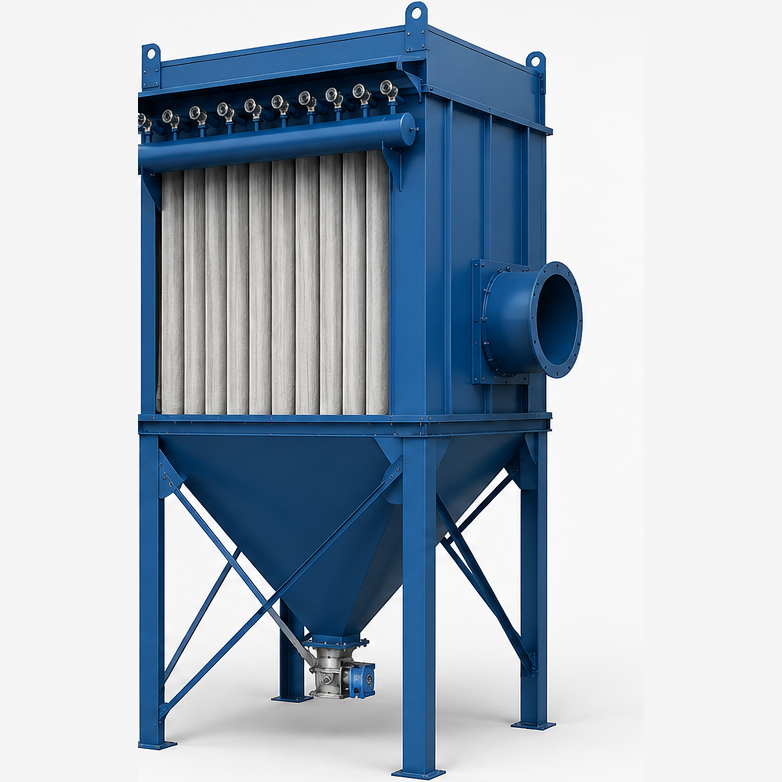
An industrial filter is the heart of any dust extraction and gas purification system. The right choice will determine whether the air in your shop is clean, whether you meet emissions standards, and how long the equipment will last. Let’s look at the differences between the main types of filters and how to choose the right one.
What determines the choice of filter
There is no universal filter; the type is selected for specific conditions. Key parameters:
- Nature of dust– coarse and abrasive, thin, sticky, fibrous or explosive.
- Dust concentration– grams or tens of grams per cubic meter.
- Gas temperature– cold air or hot gases up to 400°C and above.
- Volume (flow) of gas— from one installation to hundreds of thousands of m³/h.
- Humidity and aggressiveness– dry dust or gases with acid vapors, moisture, resins.
Bag filters
The most common type for high dust levels. The dusty gas passes through the fabric sleeves, the dust settles on the surface, and the purified air comes out. The hoses are periodically regenerated (pulse blowing).
When to choose: high concentration of dust, metallurgy, cement, thermal power plant. Efficiency – up to 99.9%. For hot gases, heat-resistant hoses are used. More details in the sectionbag filters.
Cartridge filters
Instead of sleeves there are compact folded cartridges with a large filtration area. Take up less space with the same performance.
When to choose: fine dry dust of moderate concentration – woodworking, metalworking, welding aerosol, packaging lines. A good solution where there is little space. Lookcartridge filtersanddust collection units.
Electrostatic filters (ESP)
The particles are charged in the electric field and deposited on the electrodes. Works well with fine aerosols and hot gases with low flow resistance.
When to choose: very fine dust and aerosols, oil mist, flue gas ash, large volumes. Section –electrostatic filters ESP.
Cyclones and scrubbers: when needed
Cyclonesseparate dust due to centrifugal force. They themselves do not catch fine dust, but are irreplaceable asfirst stage— remove coarse and abrasive fractions and protect the main filter from wear.
Wet scrubbersbind dust and harmful gases with water. They are chosen for hot, humid and aggressive flows, as well as in chemistry to neutralize acidic and alkaline gases.
Comparison table
| Filter type | Dust | Temperature | Efficiency |
|---|---|---|---|
| Sleeve | High concentration, any dry | up to 200°C (heat-resistant – higher) | up to 99.9% |
| Cartridge | Fine dry, moderate | up to 80 °C | up to 99.9% |
| ESP | Fine aerosols, fog, ash | high | up to 99% |
| Cyclone | Rough, abrasive (pre-cleaning) | high | 85–95% |
| Scrubber | Hot, wet, corrosive gases | very tall | up to 99% |
How to choose a filter for a task
In practice, several stages are often used: cyclone (pre-cleaning) → bag or cartridge filter (fine cleaning), and for aggressive gases – a scrubber. Accurate selection is possible only after examination: measurements of concentration, temperature and composition of dust.
ABL designs and produces all types of filters at its own production facility in Temirtau – for a specific specification. How this works in practice can be seen on the industry pages:metallurgy, cementandother industries.
Not sure which solution is right for your production? An ABL engineer will inspect the site free of charge, select equipment and calculate the cost.